Back
Hint
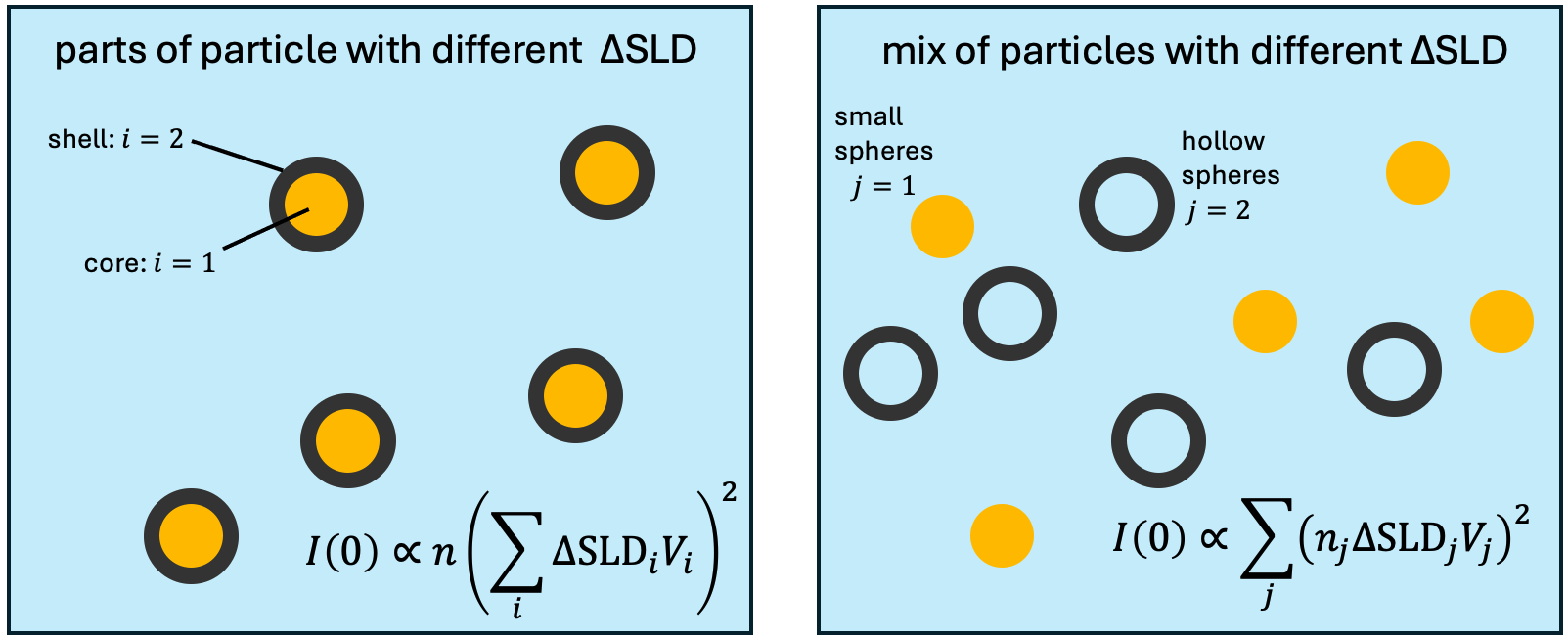
The forward scatting from a particle with domains having different $\Delta \rm SLD$s is proportional to the sum:
$$I(0)\propto(\Sigma_i\Delta\mathrm{SLD}_i V_i)^2$$
where $\Delta\mathrm{SLD}_i = \mathrm{SLD}_i - \mathrm{SLD}_\mathrm{solvent}$ is the contrast (or excess scattering length density) of subunit $i$, and $V_i$ is the volume of that subunit. A core-shell particle consists of two subunits (core and the shell), defined by regions with approximately constant contrast.
In this problem, $\Delta\mathrm{SLD}_\mathrm{core} = -\Delta\mathrm{SLD}_\mathrm{shell}$, so the volumes of the core and shell must be equal in order to get $I(0)=0$.
The volume of the core is $V_\mathrm{core} = \frac{4\pi}{3}R_\mathrm{core}^3$, and the shell volume is $V_\mathrm{shell} = \frac{4\pi}{3}R_\mathrm{outer}^3- V_\mathrm{core}$, so
$$\frac{4\pi}{3}R_\mathrm{core}^3 = \frac{4\pi}{3}R_\rm{outer}^3 - \frac{4\pi}{3}R_\rm{core}^3$$
which gives a relation between the radii:
$$2R_\mathrm{core}^3 = R_\mathrm{outer}^3$$
- Different parts of one particle of different particles - the scattering is different!
- When considering different parts of a particle with different $\Delta \rm SLD$s, for example a core-shell particle, then the scattering is proportional to the square of the sum over these parts or subunits: $$I(0)\propto(\Sigma_i\Delta\mathrm{SLD}_i V_i)^2$$ In that way we take into account scattering from cross-terms between for example core and shell
- However, for a sample with different particles that do not form complexes (for example a mix of monomers and dimers of a protein), the scattering is just the sum of scattering from the populations (the sum of squares, instead of the square of the sum). $$I(0)\propto\Sigma_jn_j(\Delta\mathrm{SLD}_j V_j)^2$$ where $j$ is over the different particle populations, and $n_j$ is the number density of each population.